Your Dog’s Brain Processes Human Speech in a Way Scientists Didn’t Expect
While many people who talk to their dogs wonder how much their dog actually understands, researchers in Budapest, Hungary, looked at something else: what happens in a dog’s brain when they hear speech.
As a trainer, I use some words as cues; I also talk casually to my dogs, and I’ve wondered how much of what I say they learn to associate with things. Who doesn’t? You’ve probably taught your dog a few cues, like the word sit, meaning to sit.
Then there are the ones we don’t train on purpose, but dogs still learn. If you have to spell out “w-a-l-k” or “r-i-d-e,” then you know exactly what I mean.
I can’t say I’ve ever wondered how a dog segments speech, though, so I was excited to read a study in Science published on September 24, 2026, to learn what the researchers at the Neuroethology of Communication Lab at Eötvös Loránd University discovered.

How Human Brains Use Consonants to Segment Words
Before understanding how a dog segments speech, we have to go back, way back, to when we first learned about vowels and consonants. If you need a reminder, speech sounds can generally be divided into vowels and consonants. Vowel sounds are produced with relatively unrestricted airflow, while consonant sounds typically involve some restriction or obstruction of airflow, according to an article published on Literacy Learn.
“Although vowels are louder and more noticeable, consonants usually form the skeleton of words,” said Attila Andics in a press release about the Neuroethology of Communication Lab’s discovery. Andics is a cognitive neuroscientist, head of the European Research Council-funded Neuroethology of Communication Lab, and the corresponding author of the study, “Neural evidence that dogs segment the speech they hear with a humanlike consonant bias.”
“In a continuous speech stream, it is easier to detect individual words when we focus on consonants,” Andics said. “And from infancy onward, this is exactly what the human brain tends to do.”

Inside the Study: EEG Testing on Dogs and Humans
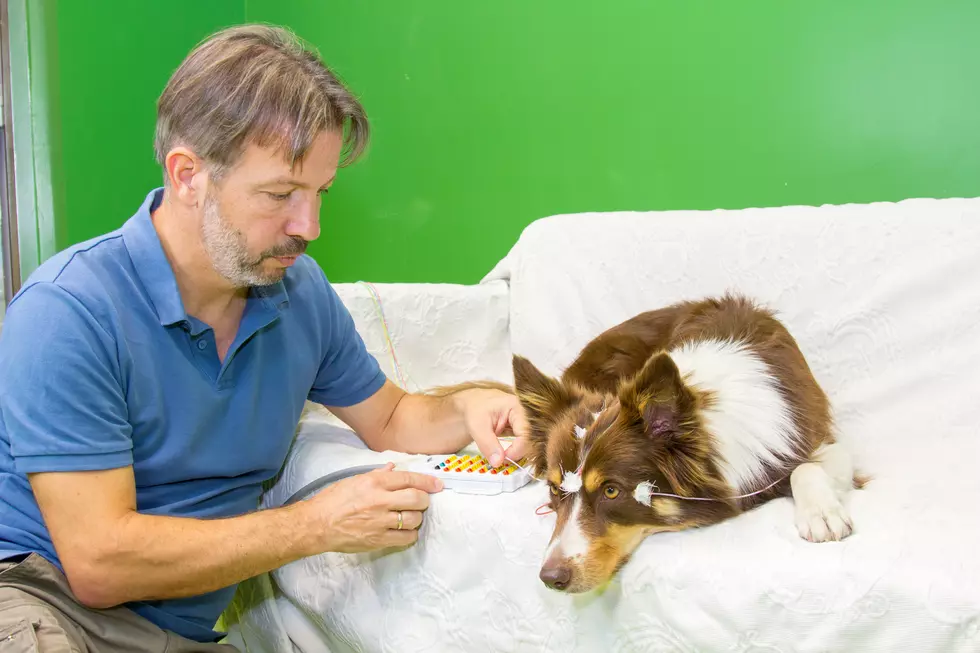
To find out how dogs segment speech, the researchers used non-invasive electroencephalography (EEG). Electrodes were placed on the scalps of participants, including 20 dogs and 20 humans.

The EEG recorded the brain’s electrical activity while the human and dog participants listened to three types of continuous, unsegmented speech streams. The streams included consonant-structured and vowel-structured speech patterns along with a control stream.

Neural Proof: The Discovery of Canine Consonant Bias
“In the consonant-structured speech streams, the dog brains, just like the human brains, successfully synchronized with the rhythm of the words, ” said Kinga G. Tóth, psychologist, the study’s other co-first author, and a doctoral researcher in the group. “In both species, this synchronization was stronger than in either the vowel-structured or the control streams. This is the first evidence that a consonant bias can also emerge in the brain of a species other than humans.”

Pattern Learning vs. Language Genetics in Dogs
Dogs exposed to a more speech-rich early environment did not show a stronger consonant bias than dogs with less early speech exposure. “This provides further evidence that consonant bias does not require pre-wired language-processing mechanisms that emerge during a specific early developmental period,” Tóth said. “Instead, this neural preference may also emerge through relatively simple forms of pattern learning.”
“Taken together, these findings suggest that the brain’s tuning to speech – and specifically the emergence of consonant bias – does not require a pre-wired brain and human-like language abilities,” Andics said. “Instead, regular exposure to speech may be enough to change how the brain functions and to give rise to processing characteristics previously observed only in humans – even in a species evolutionarily distant from us.”

As someone who spends a lot of time with dogs, I often wonder about how they process the world. This study reminds us that science still has much to reveal about our canine companions.
So the next time you talk to your dog, you might not know exactly what they understand, but this research suggests that their brains have a consonant bias much like ours do.

RANKED: Here Are the 63 Smartest Dog Breeds
Gallery Credit: Sabienna Bowman
More From WFHN-FM/FUN 107